
 By Keven Galolo
You don’t actually struggle to meet people—you struggle with the way people expect you to do it.
The Quiet Advantage Nobody Talks About
There’s a familiar pattern most introverts recognize. You open a group chat, type a reply, delete it, rewrite it, then close the app. Not because you have nothing to say, but because saying it feels like stepping into something unstructured and fast-moving. Meanwhile, other people respond instantly, as if conversation requires no effort at all.
Online spaces shift that dynamic. You can think before responding, choose when to engage, and control how visible you are. That change alone explains why introverts meeting people online often do better than they expect.
Introverts often find it easier to meet people online because they can control pace, visibility, and timing. Unlike real-time conversations, online interaction allows thoughtful responses, reduces pressure, and makes building connections more manageable.
What Meeting People Online Actually Looks Like Now
Meeting people online is no longer about random chats or forcing small talk with strangers. Most interactions now happen inside shared spaces—communities, comment threads, or interest-based groups where conversation already has context.
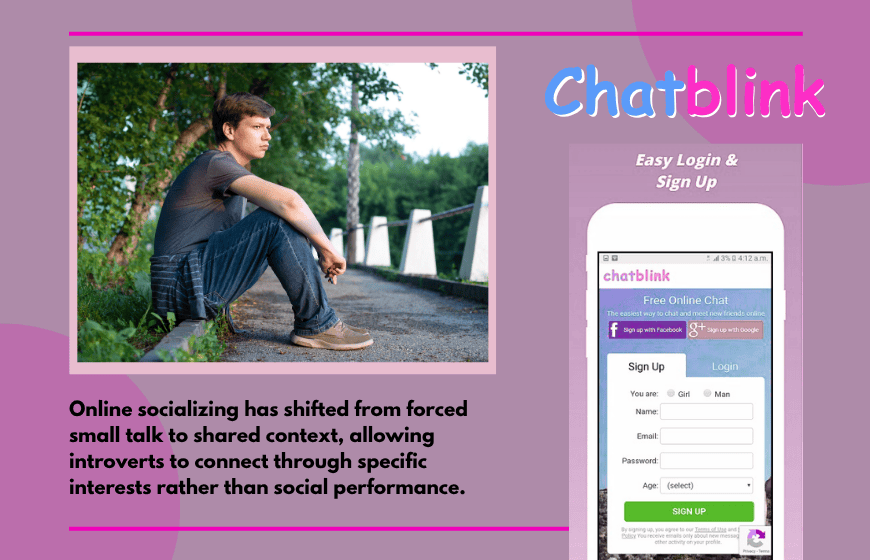
This matters because it removes the pressure to perform. You’re not starting from nothing. You’re responding to something specific, which makes online socializing for introverts more manageable and less artificial.
Why Online Interaction Feels More Natural
The difference comes down to pace and control. Offline conversations move quickly and demand constant attention. Online conversations don’t.
You can pause before replying. You can leave and return later. You can choose which conversations to engage in at all. These are small shifts, but they make building friendships as an introvert more sustainable over time.
There’s also less pressure to react immediately, which tends to lead to more thoughtful conversations rather than quick, surface-level exchanges.

Connect Instantly with People Worldwide!
Join thousands of conversations happening right now. Chat anonymously and discover exciting chat rooms.
The Real Friction: Misreading Signals
The difficulty isn’t always anxiety. Often, it’s interpretation.
It’s easy to assume that a slow reply means disinterest or that a short message means something went wrong. In most cases, neither is true. People get distracted, lose track of conversations, or simply don’t respond with much depth.
If you treat every gap as a signal, you’ll lose momentum quickly. One of the more practical tips for introverts in online communities is to stop over-interpreting silence. Most of it has nothing to do with you.
Choosing Platforms That Don’t Drain You
Not every platform is built the same way. Some demand constant interaction, while others allow you to engage at your own pace.
If you’re trying to reduce pressure, focus on environments where conversation is structured or asynchronous.
- Forums and interest-based communities allow longer, more thoughtful responses
- Instagram and Pinterest support low-effort interaction through comments and reactions
- Smaller Discord servers provide ongoing discussion without overwhelming volume
- Messaging apps with no expectation of instant replies reduce urgency
The best platforms for introverts are the ones that don’t require you to be “on” all the time.
Presenting Yourself Without Overthinking It
“Personal branding” tends to sound more complicated than it needs to be. You’re not building a persona. You’re making it easier for people to understand what you’re interested in.
A simple profile that reflects your actual interests works better than something polished or strategic. If someone can quickly tell what you enjoy talking about, conversations start more naturally.
Clarity is more useful than creativity here. You’re not trying to impress people—you’re trying to attract the right kind of interaction.
Starting Conversations Without Making It Awkward
The first message feels like the hardest part, but it doesn’t need to be complicated.
Focus on what’s already there. Reference something specific, ask a simple question, or respond to a shared interest. This removes the pressure to come up with something clever.
- Comment on a post or idea they shared
- Ask a direct but open question
- Add a short, relevant observation
For example, instead of sending a generic greeting, respond to something concrete. That alone makes casual chat for introverts feel less forced.
Setting Boundaries Early
Online interaction can become draining if you don’t manage it. The issue isn’t the number of conversations—it’s the lack of limits.
You don’t need to reply immediately. You don’t need to stay in every conversation. You don’t need to share more than you’re comfortable with.
These boundaries are not rules you announce. They are habits you maintain. Without them, even low-pressure interaction becomes exhausting.
Using Online Events Without the Pressure
Online events can work if they’re structured and tied to a clear interest. The problem is not the format—it’s the lack of direction in most events.
Smaller groups and defined topics reduce uncertainty. You don’t have to participate constantly; listening is enough to stay involved.
If you’re organizing one, keep it simple.
- Limit the number of participants
- Choose a specific topic or activity
- Make participation optional
This turns the event into something predictable rather than overwhelming.
Managing Anxiety Without Trying to Eliminate It
Trying to “fix” anxiety usually makes it worse. A better approach is to manage how you respond to it.
Before replying, give yourself a moment. There’s no urgency. You’re not in a live conversation. That alone reduces pressure.
During interaction, notice when you start overthinking. Step away if needed. Online spaces allow that in a way offline ones don’t.
Overcoming social anxiety online is less about confidence and more about pacing.
What Progress Actually Looks Like
There’s an assumption that success means becoming more social or building a large network. For most introverts, that’s not the goal.
A more realistic outcome is a few consistent, low-pressure connections. Conversations that continue without effort. Interactions that don’t feel forced.
That’s enough. And in most cases, that’s what people are actually looking for.
The Role of Culture in Online Interaction
Different spaces operate under different norms. Some encourage fast, frequent replies. Others lean toward slower, more thoughtful exchanges.
If you’re interacting across cultures, this becomes more noticeable. What feels distant in one context might be normal in another.
Understanding this prevents unnecessary doubt. Not every difference in communication is a problem.
Small Tools That Make a Difference
You don’t need to change how you communicate, but you can make the process easier.
Simple adjustments—like managing notifications or using scheduling tools—reduce unnecessary pressure. Even keeping track of conversations can help you feel more in control.
These changes don’t transform your personality, but they make online socializing for introverts more sustainable.
What Happens If You Avoid This Entirely
Avoiding online interaction doesn’t protect your energy as much as it limits your options. Many meaningful connections now start in digital spaces, especially those built around shared interests.
At the same time, approaching these spaces without structure leads to the same exhaustion you’re trying to avoid.
The outcome depends less on whether you participate and more on how you approach it.
If you already have control over pace, timing, and visibility—what part of this still feels harder than it should?
FAQs
Is it easier for introverts to meet people online?
Yes, online platforms allow introverts to control timing, pace, and visibility, making conversations less overwhelming.
How can introverts start conversations online?
By referencing something specific, asking simple questions, or responding to shared interests.
What are the best platforms for introverts?
Platforms with structured or asynchronous communication, such as forums, chat rooms, or smaller communities.
How do introverts avoid overthinking messages?
By focusing on simple responses and avoiding assumptions about delays or short replies.
Can introverts build real friendships online?
Yes, many meaningful relationships start in low-pressure, interest-based online environments.