
 By Keven Galolo

Key Takeaways
- ASL means age, sex, location. Think twice before answering it.
- WYD, LMK, and IKR are casual and safe to use.
- Match your abbreviations to your audience, not your speed.
- Context decides meaning, so check before replying.
- Spell it out when clarity matters.
If you’ve ever stared at a chat message wondering whether you’ve been insulted or invited somewhere, this chat abbreviations list is for you. We’ll start with the four everyone asks about, then cover the rest you’ll run into.
The Big Four
| Abbreviation | Stands for | Example |
| ASL | Age, sex, location | “asl?” |
| WYD | What are you doing? | “wyd tonight?” |
| LMK | Let me know | “lmk if you’re free” |
| IKR | I know, right? | “that movie was so long.” “ikr!” |
A quick note on ASL: in a chat context it has nothing to do with American Sign Language. It’s a request for your age, gender, and location in one go. I’d skip answering it with real details. Strangers asking for all three in the first message are collecting information, not making conversation.

Everyday Shorthand
| Abbreviation | Meaning |
| BRB | Be right back |
| IDK | I don’t know |
| TBH | To be honest |
| NGL | Not gonna lie |
| BTW | By the way |
| FYI | For your information |
| NVM | Never mind |
| IMO | In my opinion |
| TTYL | Talk to you later |
| G2G / GTG | Got to go |
| OMW | On my way |
| AFK | Away from keyboard |
| IRL | In real life |
| DM | Direct message (private message) |
| HMU | Hit me up (contact me) |
| FR | For real |
| SMH | Shaking my head (disapproval) |
| TMI | Too much information |
| ICYMI | In case you missed it |
| JK | Just kidding |
Reading Them in Context
The same letters can change tone depending on how they’re used. Here are two scenes.
Them: wyd
You: just finishing dinner, you?
Them: nothing much. lmk if you wanna hang out later
Friendly, casual, no pressure. “WYD” is simply a conversation starter.
Them: hmu
You: hit you up about what?
Them: whatever u want lol
Here the ambiguity is the point. “HMU” can mean “text me” or “I’m open to an offer.” When the meaning isn’t clear and the person is a stranger, ask a direct question before agreeing to anything.
When to Use Abbreviations (and When Not To)
Texting shortcuts are built for speed, not subtlety. Before sending a string of letters, run your message through three quick filters:
- Does the other person use them? Mirror the other person’s baseline. If they write in complete, punctuated sentences—whether it’s a boss, a client, or a friend who prefers full words—match that effort. Dropping casual shorthand into a formal or structured conversation makes you look rushed or disengaged.
- Is the topic serious or emotional? Context dictates effort. If someone is sharing bad news, venting, or opening up, responding with “tbh idk what to say” signals low investment. Taking ten extra seconds to type out “To be honest, I don’t know what to say” shows you are actually paying attention.
- Could this be misread? Shortcuts strip away vocal inflection and leave room for ambiguity. If an acronym has multiple meanings (like POS, FTW, or ATM), or if a brief reply could be taken the wrong way, write the whole phrase. Clarity always beats saving a few keystrokes.
The Tone Trap Abbreviations are fine for logistics—like “omw” or “eta?”—where speed is the only goal. The problem starts when they become emotional placeholders. Single-letter or clipped replies like “k,” “ok,” or “np” often land as passive-aggressive, dismissive, or annoyed, even when your mood is completely neutral.
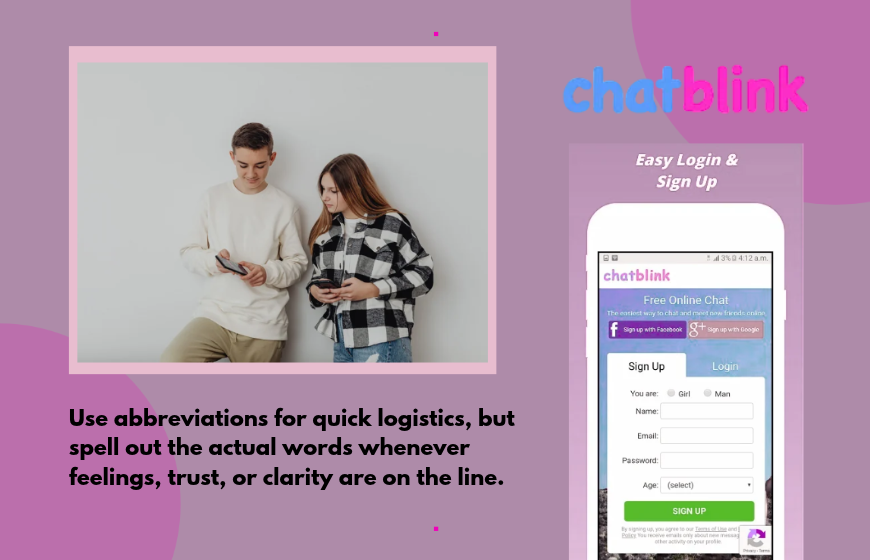
When you are just coordinating plans, keep it brief. When someone’s feelings, reputation, or trust are on the line, use the actual words.
A Word on Capital Letters
Capitals like “LMK” are standard. Lowercase “lmk” is equally common in casual chat. What changes the mood is shouting: “WYD????” with extra punctuation can read as pushy. One question mark is enough.
Are Abbreviations Bad for Language Learners?
Not at all, as long as you know when to switch. Learning them helps you read real chats, but writing full sentences keeps your grammar sharp. I’d learn all of the above and use about half of them.

Connect Instantly with People Worldwide!
Join thousands of conversations happening right now. Chat anonymously and discover exciting chat rooms.
FAQs
What does ASL mean in chat?
Age, sex, location. It’s a quick way of asking about someone’s basic profile. It doesn’t mean American Sign Language in this setting. You don’t have to answer, and giving real details to a stranger isn’t recommended.
Is “WYD” rude?
No. It’s a casual “what are you doing?” and usually just starts a conversation. Tone depends on the person asking and the situation, so a reply like “not much, you?” keeps things light.
What’s the difference between IMO and IMHO?
IMO means “in my opinion.” IMHO adds “humble” (in my humble opinion) and is often used jokingly or to soften a disagreement. Both mean the same thing in practice.
Do people still use “TTYL” and “BRB”?
Yes, though they’re less common than they were. Younger users tend to prefer “gtg” or just “bye.” Either works, and nobody will think you’re out of touch.
How can I learn new abbreviations?
Watch how people in a group chat use them and search the term if it’s new. Slang changes quickly, so no list stays complete. When unsure, ask. It’s better than guessing wrong.