
 By Keven Galolo
You feel like you’re falling behind, but the timeline itself quietly moved without asking you.
Marriage used to feel like the starting line. Now it’s more like something people circle back to later, almost as an afterthought. Not ignored, just… postponed, reshuffled, placed somewhere down the list.
And that shift? It’s not subtle anymore. It’s everywhere.
While the shift feels personal on the surface, the real drivers behind this delay are structural and repeatable.
To put it simply: People are waiting longer to get married due to financial pressure, changing cultural norms, and a stronger focus on personal growth. Marriage is no longer seen as a starting point but as a later milestone, reflecting shifting priorities around stability, independence, and long-term commitment.
Here is how we’re breaking down this shift:
Marriage Isn’t the Starting Point Anymore
Marriage, these days, doesn’t carry the same urgency it once did. Fewer people are getting married, and those who do often take their time. A lot more time. In the U.S., for instance, just over half of adults are married now, according to Pew Research Center. That number used to be higher, not dramatically, but enough to matter.
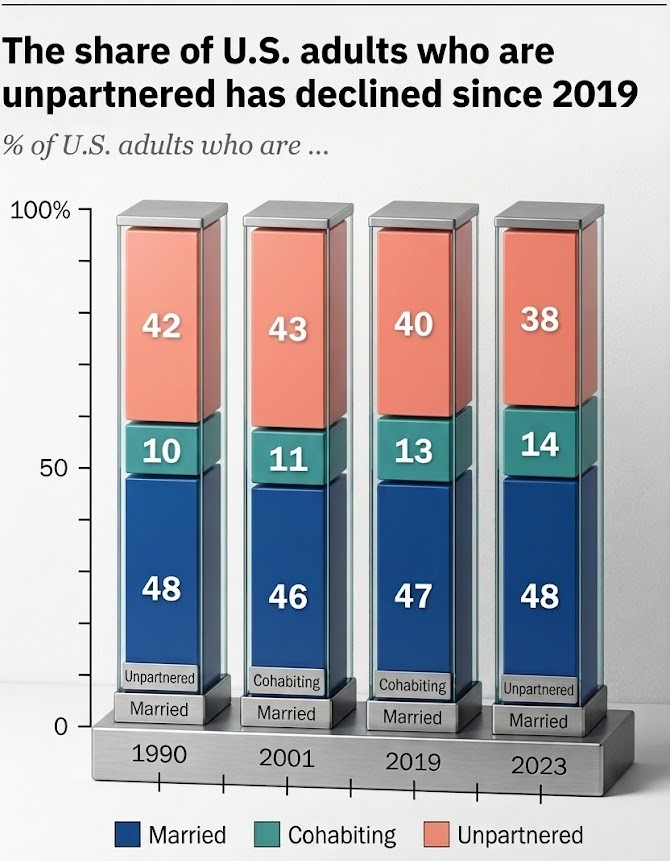
Note: While this graphic design is original, the underlying data is based on statistics from Pew Research Center. (Source)
Across the globe, the pattern repeats. People born decades ago were married by their late twenties almost by default. Today, that assumption feels outdated. In some places, barely a third of women are married by 30. That would’ve sounded absurd a generation ago. Now it’s just… normal.
Zoom out, and you see the same pattern almost everywhere.
Marriage rates have dropped across many countries. The numbers differ, but the direction is consistent. The average rate has fallen from around 5–7 marriages per 1,000 people in 1990 to about 4.3 today, based on OECD data.
Even family structures are shifting. In countries like Denmark, fewer children now grow up in married households.
Different cultures, same underlying forces. Economic pressure. Changing values. Global influence spreading similar ideas.
It’s not isolated. It’s a broad shift.
But marriage hasn’t disappeared. It’s just moved further down the timeline.
Money Quietly Drives the Delay
Money, or the lack of it, quietly sits at the center of this whole thing.
Rent’s high. Buying a house feels like a distant dream for many. Jobs? Not always stable. So people hesitate. Makes sense, right? Committing to someone for life feels heavier when your own life feels a bit shaky.
There’s also this unspoken checklist. Financial stability. Career clarity. A sense of “I’ve got things figured out.” People still want those before saying yes. Only now, it takes longer to get there. Much longer.
So it’s not that people don’t believe in commitment. They just don’t want to rush into it half-prepared. Research on long-term trends, such as this Pew analysis, supports this shift.
Culture Has Redefined What Relationships Look Like
Then there’s culture. And culture has… loosened up.
Living together without getting married? Completely normal. Having kids outside marriage? Also accepted in many places now. The pressure that once pushed people toward marriage has softened.
Back then, marriage signaled adulthood. Stability. Respectability. Now? Not so much. A solid career, independence, personal growth, those carry just as much weight, maybe more.
People define success differently now. And marriage isn’t the default marker anymore.
Technology Adds More Options and More Hesitation
Technology complicates things in a quieter way.
Dating apps. Endless scrolling. New faces, new conversations, all the time. It opens doors, sure, but it also creates this lingering thought, “what if there’s someone better just one swipe away?”
And social media doesn’t help. Perfect couples, curated lives, filtered happiness. It sets a bar that isn’t always real, but still influences expectations.
So people wait. They compare. They hesitate.
Connections happen, but commitment takes longer to land.

Connect Instantly with People Worldwide!
Join thousands of conversations happening right now. Chat anonymously and discover exciting chat rooms.
Personal Growth Comes First Now
Another piece of the puzzle, maybe the most personal one, is this growing focus on self.
People want to know who they are first. What they want. What they don’t. Millennials leaned into this, prioritizing education and careers in their twenties. Gen Z seems to be going even deeper, focusing on identity, mental health, purpose.
There’s this idea floating around now, marriage as a “capstone,” not a foundation. Something you add once your life already feels complete.
It’s an interesting flip. And honestly, it kind of makes sense.
What This Means for the Future of Marriage
So where does that leave marriage?
Not gone. Just… transformed.
People still want connection. That hasn’t changed. But they approach it more cautiously, more deliberately. When they do choose marriage, it often comes after a lot of thought, not just because “it’s time.”
And maybe that leads to stronger partnerships. Or maybe it creates new challenges. Probably both.
Either way, the story isn’t about decline in the dramatic sense. It’s about repositioning.
Marriage didn’t vanish. It just moved.
FAQs
Why are people waiting longer to get married?
People are delaying marriage due to financial instability, shifting cultural norms, expanded dating options, and a stronger focus on personal growth before committing.
Is marriage becoming less popular?
Marriage is not disappearing, but fewer people see it as an immediate priority, and many choose to marry later rather than earlier in life.
How does money affect the decision to marry?
Financial pressure, including housing costs and job uncertainty, makes people hesitant to commit until they feel economically secure.
Do dating apps make people less likely to marry?
Dating apps increase options, which can lead to comparison and hesitation, making long-term commitment feel less urgent.
Is living together replacing marriage?
In many cases, yes. Cohabitation has become widely accepted, allowing couples to build relationships without formal marriage.
Why do younger generations prioritize personal growth first?
Younger generations place more importance on identity, mental health, and career development, viewing marriage as something that comes after self-understanding.
Will people stop getting married in the future?
Unlikely. Marriage is evolving rather than disappearing, with people approaching it more deliberately and later in life.