
 By Keven Galolo
You think you’ve found something real, until the feeling starts to feel slightly rehearsed.
Most people don’t worry about scams until they almost fall for one.
It usually starts harmless. A decent conversation. Someone who replies fast. Maybe a little too attentive, but hey, that’s flattering, right? And then, somewhere between “good morning” texts and oddly perfect timing, things start to feel off. Not wrong exactly. Just slightly staged.
Online dating isn’t the problem. Not really. It’s the people who treat it like a script.
So if you’re asking how to avoid being scammed, you’re already ahead. Most don’t ask until it’s too late.
What feels like progress toward something meaningful can quietly shift into something engineered without you noticing.
To put it simply: To avoid online dating scams, watch for fast emotional escalation, inconsistent stories, and any request involving money. Staying on trusted platforms, limiting personal information, and verifying identities through video calls help reduce risk.
Before you go further, keep these signals in mind:
There’s a Pattern (And Once You See It, You Can’t Unsee It)
Scams aren’t random. They tend to follow a clear structure, almost like a playbook. It usually starts with a quick sense of connection, then things deepen faster than expected.
And just when it begins to feel emotionally settled, that’s when the request shows up. The FBI actually outlines this pretty clearly, describing romance scams as situations where fraudsters build relationships first, then introduce financial requests.
And the scale? It’s not small. The Federal Trade Commission reported over $1.3 billion lost in 2022, with a median loss of around $4,400.
That number alone tells you something. This isn’t rare bad luck. It’s a system.
What’s interesting, though, is how quickly things escalate. A few days in, they’re already talking about “connection” or “something special.” Feels rushed. Because it is.
Fake Profiles Usually Look… A Bit Too Good
You’d think fake profiles would be obvious. They’re not. Not always.
Sometimes they’re polished. Very polished. Like someone carefully picked every detail to appeal broadly.
Photos tend to look almost studio-perfect. Clean lighting, no context, no friends, no messy background. A quick reverse image search often reveals they exist elsewhere. Different names. Same face.
Bios? Oddly vague. Or strangely dramatic. You’ll see jobs like “working offshore” or “military deployment.” Convenient reasons why meeting in person is… impossible.
Even the way they talk can feel slightly off. Not wrong, just… generic. Like they’re mirroring you instead of expressing something original.
The FTC has pointed out that scammers often study their targets and reflect their preferences back to them.
That’s why it feels like you’ve met your “perfect match.” Because, in a way, you have. It’s engineered.
The Conversation Is Where It Really Shows
Profiles can be convincing. Conversations are harder to fake long-term.
Scammers move quickly. Too quickly. Emotional intensity shows up early. Compliments feel constant. There’s often a push toward exclusivity within days.
And then there’s avoidance. Video calls get delayed. Plans get canceled. Always a reason. Work, emergencies, time zones… something.
“At Chatblink, we don’t just watch for scams; we actively hunt for them to keep your conversations real and your data safe.”
The biggest signal, though? Money.
It doesn’t start with “send money.” It starts with a story. A problem. A situation that feels urgent but solvable—with your help.
Gift cards. Crypto. Wire transfers.
The CFTC has warned that many modern scams now involve fake investment opportunities, especially crypto, leading to massive global losses.
Once money enters the conversation, it’s no longer a maybe. It’s a scam. Full stop.
Trust Doesn’t Happen Overnight (And It Shouldn’t)
Safe online dating practices rely on simple, consistent habits. These habits create distance between you and potential scams.
Here are practical tips for safe online dating:
Some of this might sound a bit overcautious at first, but honestly, a little caution goes a long way online. Especially now, when scams feel almost… industrial. Anyway, here are a few habits I’ve found surprisingly effective (some are a bit unconventional, but that’s kind of the point).
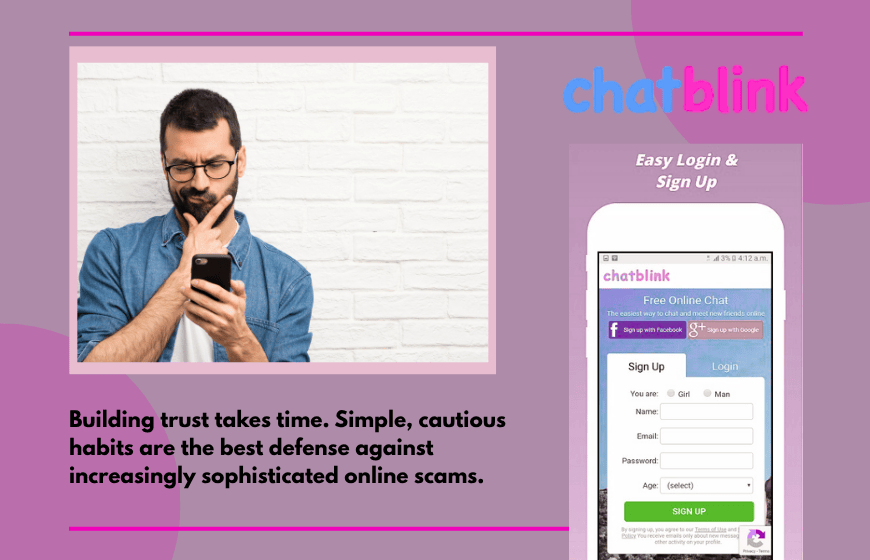
1. Stay on Chatblink as long as possible
It might feel natural to move the conversation elsewhere after a while. People do it all the time. But staying on Chatblink gives you a bit of built-in protection that you don’t really notice at first. The platform can pick up on unusual behavior and deal with suspicious accounts behind the scenes. Once you move the conversation off Chatblink, that layer is gone. And, more often than not, that’s exactly when problems start.
2. Go slow with personal details (even the small stuff)
People don’t usually think twice about sharing where they work or what their day looks like. Seems harmless. But piece by piece, someone can build a version of you and reflect it back, like a weird emotional mirror. That’s how fake closeness forms. And money talk? Just don’t. Even casual mentions can signal vulnerability in ways you didn’t intend.
3. Look for consistency in how they communicate
Without video calls, you have to rely more on patterns. Pay attention to how they write, how often they reply, and whether their story stays the same over time. Do their details line up from one day to the next? Or do things shift slightly when you ask again later? Real people tend to be consistent, even casually. Someone who keeps changing small details or avoiding simple questions might not be who they claim to be.
4. Run it by someone you trust
This one feels almost too simple, but it works. When you’re caught up in a new connection, your judgment can get a bit fuzzy. A friend, on the other hand, has no emotional stake. They’ll notice things you might gloss over. Read a message out loud to them. If it sounds odd when spoken, it probably is.
5. Try the “wrong detail” trick
Here’s a slightly sneaky one. Mix up a small detail they told you. Maybe call their dog the wrong name or say the wrong hometown. A real person will correct you right away (sometimes with a laugh). A scammer? They might just roll with it, especially if they’re juggling multiple conversations. Scripts don’t catch everything.
6. Ask for a weirdly specific photo
Not a polished selfie. Something random. Like holding a spoon. Or touching their ear. It sounds silly, I know. But it works. People using stolen photos can’t just generate a custom image on demand. It cuts through the curated, Instagram-perfect façade pretty quickly.
7. Listen to what’s behind them, not just what they say
When you finally get on a call, pay attention to the background. Put on headphones if you can. Do you hear multiple voices? Constant typing? That hollow office echo? It might not be a cozy apartment at all. Some scams run out of large, noisy setups that sound nothing like a normal home environment.
8. Set a hard rule: no money talk for 30 days
This one’s simple but powerful. If anything about crypto, investments, or sudden emergencies pops up within the first month, just walk away. No debate. Scammers rely on speed. They want trust fast, decisions faster. Slowing things down makes you… well, not worth their time.
Here’s the thing. Awareness alone doesn’t really protect you. People know scams exist, yet they still get pulled in. I think it’s because knowing isn’t the same as doing.
And the numbers don’t lie—73% of adults have run into some form of online scam. That’s not rare anymore. That’s normal.
So yeah, small habits matter. More than you’d think.
The Stories All Sound Different… Until They Don’t
If you spend any time reading real cases, you start to notice the same storyline playing out, almost like déjà vu. Someone meets a person who says they’re working overseas.
They talk every day, sometimes for weeks, sometimes longer, and it all feels surprisingly real. There’s a rhythm to it, a kind of steady build that lowers your guard without you realizing it.
Then, at some point, something shifts. An issue comes up—a medical emergency, a payment that got stuck, a sudden travel problem that needs fixing right away. The request for money follows, usually framed as a one-time thing, nothing too alarming on the surface.
The long-awaited meeting gets pushed back. Then pushed again. And eventually, the messages stop altogether, leaving behind more questions than answers.
If You Do Get Caught (Because It Happens)
First, don’t panic. And don’t stay silent. Report it. To the platform. To the FTC. To the FBI. It helps track patterns.
If money or financial data is involved, contact your bank immediately. Timing matters here.
Change passwords. Lock down accounts. Clean things up quickly. Most users encounter scam attempts at some point, even if they don’t lose money. So exposure isn’t failure. It’s part of being online, unfortunately.

Connect Instantly with People Worldwide!
Join thousands of conversations happening right now. Chat anonymously and discover exciting chat rooms.
How Do You Actually Stay Safe?
It’s not about paranoia. It’s about awareness.
Scammers depend on three things: speed, emotion, and secrecy. You counter that with patience, distance, and a bit of skepticism.
You don’t need to avoid online dating. That’s not realistic. But you do need to stay grounded. Ask questions. Slow things down. Trust actions more than words.
And if something feels slightly off? It probably is. Not always, but often enough to pay attention.
FAQs
How do you know if someone is scamming you in online dating?
Look for fast emotional intensity, inconsistent details, avoidance of video calls, and any request involving money.
What are common online dating scam red flags?
Overly polished profiles, vague bios, rushed relationships, and excuses to avoid meeting in person.
Why do scammers move conversations off platforms?
To avoid detection and remove built-in safety features that platforms provide.
Should you ever send money to someone you met online?
No. Any request for money in early stages is a strong indicator of a scam.
How can you protect yourself from dating scams?
Stay on trusted platforms, verify identities, take your time, and involve a trusted friend if unsure.