
 By Keven Galolo
Stop sending “Hey.” The best opener is already hidden in her profile.
Most people fail at first messages because they ignore the only source of real personalization available: her profile. Photos, bio, captions—these are not decoration. They are pre-built conversation hooks waiting to be used.
Personalized, meaningful questions outperform generic small talk, creating stronger connections and higher response rates . The difference is simple: one shows effort, the other shows none.
Why Generic Openers Fail (And Always Will)
A message like “Hey” or “What’s up?” fails for one reason: it is interchangeable. It could be sent to anyone.
Low effort signals low interest.
From a behavioral standpoint, people respond better when they feel seen and understood, not when they feel like part of a copy-paste list .
Generic openers:
- Show zero observation
- Create no emotional engagement
- Force the other person to carry the conversation
Personalized openers:
- Demonstrate attention to detail
- Signal intent and curiosity
- Invite natural responses
The Profile → Opener Formula (Simple System)
Here is the repeatable system that converts any profile into a strong opener:
Observation → Personalization → Open-ended question
Step-by-step:
- Identify something specific (photo, bio, interest)
- Mention it directly
- Ask a curiosity-driven question
Example:
- Observation: Guitar in photo
- Message:
“I noticed the guitar in your second photo—how long have you been playing?”
This structure works because it:
- Feels natural
- Encourages storytelling
- Avoids yes/no answers
Easy Conversation Starters from Photo Details
Photos are the highest-value source of openers because they provide visual context.
Use The Photo Detail Method
Template:
“I couldn’t help but notice that [object] in your photo. How long have you been into that?”
Examples:
- “I couldn’t help but notice your dog in the second photo—what’s its name?”
- “That book in your picture caught my attention. Was it actually good?”
- “You play piano? How did you get into that?”
Why this works:
- It proves you actually looked
- It feels specific and intentional
- It opens a natural topic of interest

Connect Instantly with People Worldwide!
Join thousands of conversations happening right now. Chat anonymously and discover exciting chat rooms.
Travel Tease: Turn Locations Into Conversations
Travel photos are one of the easiest ways to start a compelling message.
Use The Travel Tease Approach
Template:
“That place in your photo looks incredible. Is that local or a vacation highlight?”
Examples:
- “That beach in your background looks unreal. Is that nearby or a trip?”
- “Where was that mountain shot taken? It looks like a postcard.”
- “That café looks like Europe—am I close?”
Why this works:
- Travel is emotionally engaging
- It invites storytelling
- It creates shared curiosity
Bio Deep-Dive: The Most Underrated Strategy
Most people skim bios. That is a mistake.
A well-written bio contains personality cues that can be turned into high-quality openers.
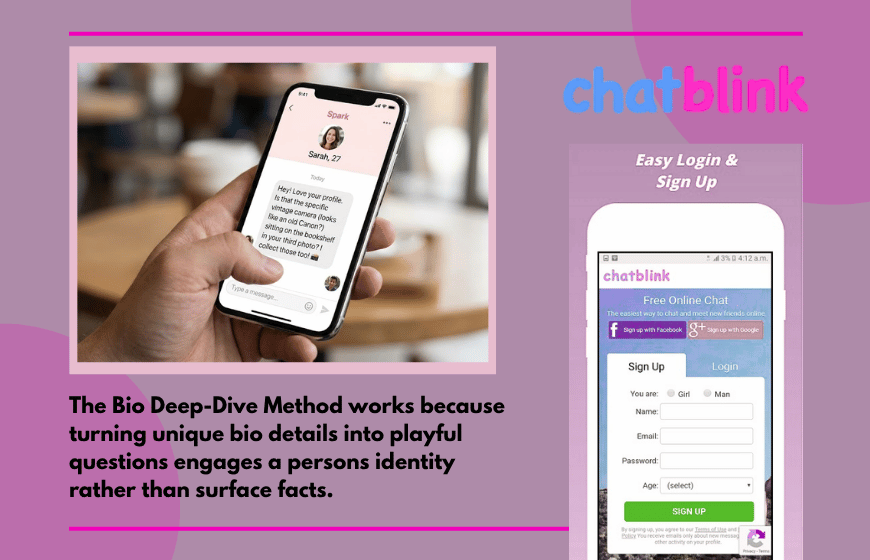
Use The Bio Deep-Dive Method
Template:
“You mentioned [bio detail]. What’s the story behind that?”
Example:
- “You said you’re a ‘professional over-thinker’—what’s the most random thing you’ve over-analyzed today?”
Other examples:
- “You claim to make the best coffee—what’s your secret?”
- “You’re into spontaneous trips—what’s the most last-minute one you’ve done?”
Why this works:
- It engages identity, not surface facts
- It feels playful but thoughtful
- It encourages longer responses
Why Personalized Openers Work (Backed by Psychology)
Personalized messaging is effective because it aligns with how humans interpret attention and interest.
Key findings from behavioral research:
- People prefer deeper, more meaningful questions over small talk
- Curiosity-driven questions increase likability and engagement
- Individuals want to feel noticed and understood, even by strangers
The real signal isn’t the message—it’s the effort behind it.
A personalized opener communicates:
- “I chose you specifically”
- “I paid attention”
- “I’m interested in who you are”
Good vs Bad Openers (Clear Comparison)
❌ Bad Openers
- “Hey”
- “Hi”
- “What’s up?”
- “How are you?”
These fail because they:
- Are generic
- Require effort from her
- Provide no direction
✅ Good Openers
- “I noticed your camera—are you into photography or just casually good at it?”
- “That hiking photo looks intense. Worth the climb?”
- “You mentioned you love podcasts—any underrated ones I should know?”
These succeed because they:
- Show observation
- Ask open-ended questions
- Create momentum immediately
How to Keep the Conversation Going After the First Message
The opener gets attention. The follow-up builds connection.
Use This Simple Rule:
Ask better follow-up questions, not more questions.
Instead of:
- “Oh nice”
- “Cool”
- “Same”
Use:
- “What got you into that?”
- “What do you enjoy most about it?”
- “Would you recommend it to someone new?”
This keeps the conversation:
- Flowing naturally
- Focused on her interests
- Engaging instead of forced
Takeaway: The Best Opener Is Already Written
You don’t need clever lines. You don’t need gimmicks.
Everything you need is already there:
- Her photos
- Her bio
- Her interests
Your job is to notice, personalize, and ask.
The formula is simple:
- Look closely
- Pick one detail
- Ask a genuine question
That alone puts you ahead of most people.
If applied consistently, this approach transforms your messaging from ignored to engaging, because it replaces randomness with intentional communication.