
 By Keven Galolo
Chit chat in online chat rooms is about starting quickly and keeping the interaction easy to continue. A good opener creates just enough interest for the other person to reply instead of skipping.
Chit chat in online conversations works best when messages are simple, relevant, and easy to answer. Using light openers, icebreaker questions, and short follow-ups helps start conversations quickly and keep them flowing naturally.
Why Online Chit Chat Works Differently
Online conversations remove tone and body language. What remains is text, timing, and intent.
This makes first messages more important. People decide quickly whether to stay or move on. A conversation starter in this context is a short, clear message designed to get a response without friction.
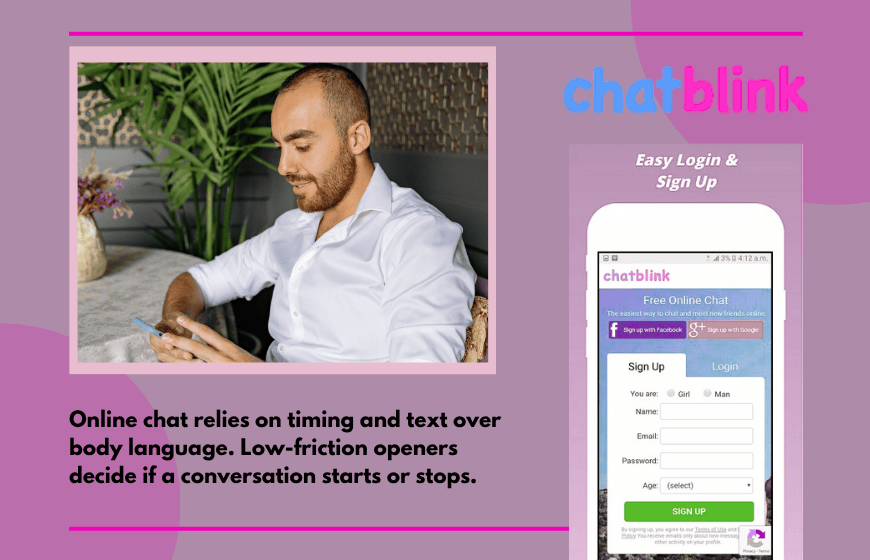
Chatblink amplifies this behavior. You are often one message away from being continued or skipped. Start a conversation online easily with these steps.
1. Start With a Light, Context-Free Opener
In most chat rooms, you have no shared context. You are matched instantly with someone you do not know.
That means your first message should be simple and easy to answer. It should not require effort to respond.
Examples:
- “Hey, what kind of chats do you usually enjoy here?”
- “Quick one—are you here to pass time or meet people?”
- “Hi, what’s been your most interesting chat so far?”
- “Hey, what usually makes you stay in a conversation?”
- “What’s your vibe today—random chat or something meaningful?”
These openers work because they are relevant to the platform itself. They immediately connect both users.
2. Use Playful Icebreaker Questions
Playfulness increases replies in online settings. It adds energy without needing long explanations.
Good icebreaker questions are short, slightly curious, and easy to answer.
Examples:
- “Let’s keep it simple—coffee or tea?”
- “Would you rather travel anywhere or stay home forever?”
- “What’s one small thing that made your day better?”
- “If we had to talk about one topic, what would you pick?”
- “What’s your go-to way to spend time online?”
These questions reduce pressure. They also create a quick rhythm in the chat.
3. Use Small Talk Ideas That Fit Chat Behavior
Online small talk is shorter and more direct than in-person conversations. Long messages often slow things down.
The best small talk ideas are quick to answer but flexible enough to expand.
Examples:
- “What are you usually doing when you open chat apps like this?”
- “Are you more of a late-night chatter or daytime person?”
- “Do you prefer talking to strangers or people you know?”
- “What’s your usual mood when you come here?”
- “Do you ever end up in unexpectedly good conversations here?”
These feel natural because they reflect real behavior on platforms like Chatblink.
4. Share Personal Anecdotes That Invite a Response
A personal anecdote adds personality. It makes the conversation feel human instead of transactional.
In chat rooms, it needs to be short and open-ended.
Examples:
- “I came here just to pass time once and ended up talking for hours.”
- “I usually skip fast, but sometimes conversations surprise me.”
- “I had one chat here that completely changed my mood.”
- “I didn’t expect to enjoy random chats this much when I started.”
- “I once met someone here who had the exact same interests.”
These statements invite the other person to share their own experience.
5. Ask Follow-Up Questions That Keep Momentum
Online conversations end quickly without follow-ups. There is always another chat available.
Follow-up questions show interest and keep the exchange moving.
Examples:
- “What made that conversation stand out?”
- “Do you usually find chats like that?”
- “What do you look for in a good conversation here?”
- “Would you stay longer if the chat is interesting?”
- “What makes you skip instantly?”
These questions help transition from basic chit chat into more engaging topics.

Connect Instantly with People Worldwide!
Join thousands of conversations happening right now. Chat anonymously and discover exciting chat rooms.
6. Introduce Engaging Topics That Work in Chat
An engaging topic invites opinions or short stories. It should not require long explanations.
Timing matters. Introduce these after a few exchanges, not at the very start.
Examples:
- “Do you think people act differently online than in real life?”
- “What’s something people pretend to like but don’t?”
- “Do you think random chats can lead to real connections?”
- “What’s the most unexpected thing someone told you online?”
- “Is chatting with strangers easier than talking in real life?”
These questions often extend conversations naturally.
7. Adapt to Chatblink’s Different Modes
Chatblink allows both random matching and topic-based chat rooms. Each requires a slightly different approach.
In random chat, speed matters. In chat rooms, relevance matters more.
Examples:
- Random chat: “Hey—what made you stop on this chat?”
- Random chat: “Quick one—what’s your mood today?”
- Chat room: “How did you get interested in this topic?”
- Chat room: “Do you come here often or just exploring?”
- Chat room: “What’s your take on what people are discussing here?”
Matching your opener to the format increases response rates.
8. Use Text-Based Non-Verbal Cues
Without body language, tone must be expressed through writing style.
Small adjustments make your messages feel more natural.
Examples:
- Use short, clear sentences instead of long paragraphs
- Add light reactions like “haha” or “that’s interesting”
- Avoid sending multiple messages too quickly
- Match the other person’s tone and pace
- Keep spacing clean to improve readability
These cues replace facial expressions and tone.
9. Use Memorable Experiences to Build Connection
A memorable experience gives the conversation something concrete to build on. It creates relatability.
Short experiences work best in online chat.
Examples:
- “I once had a random chat turn into a real friendship.”
- “I met someone here who had the same mindset as me.”
- “I had a chat that completely shifted my mood that day.”
- “I’ve had both the best and weirdest conversations here.”
- “I didn’t expect meaningful chats here, but they happen.”
These prompts make the interaction feel more real.
10. Know When to Continue or Exit Smoothly
Not every chat will work. Ending it cleanly is part of good online interaction.
A smooth exit keeps things positive and avoids awkward silence.
Examples:
- “This was a good chat—glad we connected.”
- “I might hop to another chat, but this was interesting.”
- “Let’s continue if we match again sometime.”
- “Nice talking to you—hope you find a great conversation.”
- “I’ll leave this here, but this was a good exchange.”
This keeps the experience respectful and natural.
Why Chatblink Supports Better Chit Chat
Chatblink is designed for fast, anonymous interaction. That aligns with how modern chit chat works.
Users can move between random chat and topic-based rooms without friction. This allows both quick exchanges and longer conversations.
The platform supports what matters most in online chit chat: speed, simplicity, and the ability to explore conversations without pressure.
FAQs
What is chit chat in online chat rooms?
Chit chat online is informal, quick conversation used to connect with strangers without commitment.
How do you start a conversation in random chat?
Use short, relevant openers that are easy to answer and feel natural in a chat environment.
What are good conversation starters for Chatblink?
The best starters are simple, platform-relevant, and invite a quick response without pressure.
How do you keep online conversations going?
Ask follow-up questions, share short personal anecdotes, and introduce engaging topics at the right time.
Can chit chat online lead to real connections?
Yes. While many chats are brief, some develop into longer conversations, friendships, or relationships depending on compatibility.