
 By Keven Galolo
You’re not bad at talking—you’ve just avoided enough reps to make it feel that way.
Most of us want to be better at talking to people, but the moment a real human stands in front of us (coffee line, elevator, jeepney ride), our brain suddenly forgets how words work.
Why does that happen?
And more importantly… can you fix it without turning into some overly confident, fake-smiling version of yourself?
Short answer: yes, you can. Not overnight, though. It’s more like learning to swim—you don’t read about it and magically float. You get in the water, awkwardly at first. Let’s go step by step.
Talking to Strangers Isn’t Talent—It’s Repetition (Messy, Real Repetition)
Here’s something people don’t always believe at first: social skills aren’t something you’re “born with.” They’re trained. Slowly. Sometimes painfully.
A study in the Journal of Experimental Social Psychology found that even a week of regular small conversations can lower social fear and boost confidence. A week. Not months. That surprised me too.
What’s happening is pretty simple. Your brain stops treating strangers like threats. At first, every interaction feels risky (What if I say something dumb? What if they ignore me?). But after repeating it enough times, your brain goes, “Oh… this again? We survived last time.”
And then it relaxes a bit.
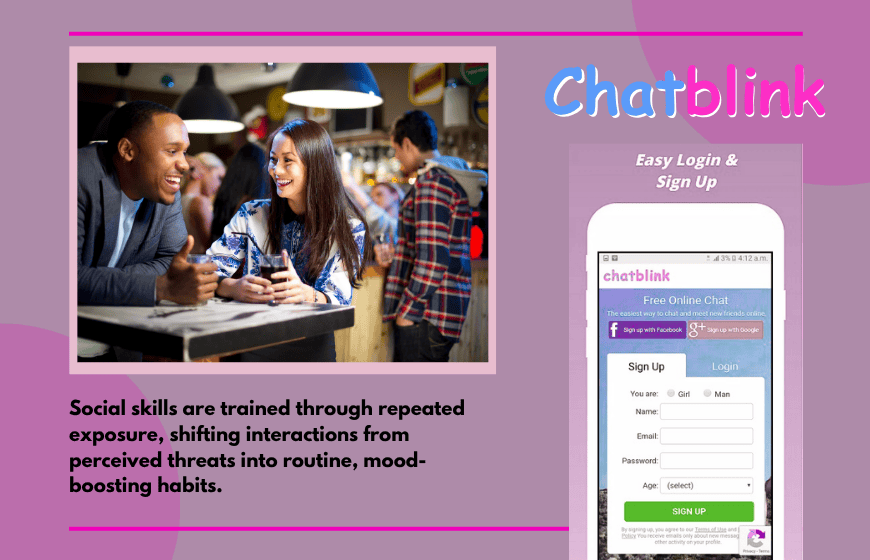
There’s also this small but interesting finding: commuters who chatted with strangers reported better moods than those who stayed quiet. Sounds counterintuitive, right?
So even those tiny, almost forgettable conversations? They count. They really do.
Before You Speak, Your Body Already Did
You haven’t said a word yet, but somehow the other person has already decided whether you’re approachable. Slightly unfair, but that’s how humans work.
Posture, eye contact, even how your shoulders sit—these things send signals faster than speech.
Now, I’m not saying you need perfect posture like a mannequin. That’s unrealistic.
But small tweaks help. Face people when you talk. Keep your hands visible. Try a relaxed stance (even if inside you’re panicking a bit, which, honestly, happens).
Because here’s the thing: people respond to what they see first, not what you plan to say.
It sets the tone.
If Real Life Feels Too Much, Start Online (No Shame in That)
Not everyone wants to jump straight into chatting with strangers at a café. That’s fine.
Actually, using random video chat platforms can be a surprisingly effective practice space. You can leave anytime. No awkward “exit strategy” needed. No long-term consequences.
That freedom matters.
It creates a low-pressure environment where you can try things out—simple greetings, asking questions, even just holding eye contact through a screen (which is harder than it sounds, by the way).
“The digital world provides a safe laboratory
for social experimentation.”
Over time, something shifts. You get used to interaction itself.
Then, when you move offline, it doesn’t feel like starting from zero. It feels familiar.

Connect Instantly with People Worldwide!
Join thousands of conversations happening right now. Chat anonymously and discover exciting chat rooms.
Cultural Differences… Yeah, They Matter More Than You Think
Here’s a subtle one people often overlook.
Not everyone communicates the same way. What feels friendly in one place might feel rude somewhere else. Eye contact is a good example—confident in some cultures, too intense in others.
Once you notice this, you can’t unsee it.
Being aware of these differences helps you avoid those “wait… did I say something wrong?” moments. It also makes the other person feel more at ease, even if they can’t explain why.
You don’t need to memorize cultural rules. Just pay attention. Adjust a little. That’s usually enough.
A Simple 30-Day Plan (That Won’t Overwhelm You)
Here’s the thing most people don’t admit: trying to “fix” your social skills in one big push usually backfires. You get excited for a day or two, then it fades, and suddenly you’re back to avoiding eye contact at the grocery store like nothing happened.
So instead, think smaller. Almost boringly small.
Because small actions repeat. And repeated actions stick.
Let’s walk through this in a way that actually feels doable, not like some motivational checklist you’ll forget by next week.
Days 1–5: Just exist a little more openly
At this stage, you’re not trying to impress anyone. You’re just getting used to being seen.
Make eye contact when passing people. Hold it for a second longer than usual. Add a small smile—not exaggerated, just enough to signal “I’m not closed off.”
It might feel awkward. Actually, it will feel awkward. That’s kind of the point.
Your brain is adjusting to visibility.
Days 6–10: Add tiny verbal cues
Now you layer in sound. Nothing complex.
A quick “hi,” “morning,” or even a nod with a word attached. Cashiers, guards, coworkers, people in elevators—low-stakes interactions are your training ground.
Some people will respond warmly. Others won’t. That’s fine. Don’t overthink it.
You’re building tolerance, not chasing perfect reactions.
Days 11–20: Start short, low-pressure conversations
This is where things shift a bit.
Instead of just greetings, you add one extra line. Something situational works best because it doesn’t feel forced. Ask for directions (even if you half-know them), comment on the weather, or say something simple like, “Is it always this busy here?”
You’re not trying to be interesting—you’re trying to keep the interaction going for a few seconds longer than before.
Some conversations will die quickly. That’s normal. Honestly, expect it.
But a few will stretch a bit further, and that’s where you start noticing progress.
Days 21–30: Hold slightly longer conversations (or practice online)
By now, you’ve built a bit of rhythm.
This stage is about staying in the conversation longer without rushing to escape. Ask follow-up questions. React to what the other person says. Let the exchange breathe a little.
If face-to-face still feels heavy some days (and it will, let’s be honest), you can mix in random video chat platforms. They give you a strange kind of freedom—you can try, fail, reset, and try again without carrying the moment with you all day.
It’s not exactly the same as real life, but it helps bridge the gap.
And here’s the part people overlook
Progress doesn’t feel dramatic.
There’s no big “aha” moment where you suddenly become confident. It’s quieter than that. One day you realize you didn’t hesitate as much. Another day, a conversation lasts longer than expected. Then eventually, it just… feels normal.
That’s how it works. Brief social interactions can lift your mood and reduce feelings of isolation. Small wins don’t look impressive in the moment. But they add up.
Stop Overthinking What to Say—Just Listen Better
This one’s underrated.
Most people stress about what to say next. That’s where the awkward pauses come from. You’re stuck in your own head.
Try flipping it.
Focus on what the other person is saying instead. Really listen. Nod a bit. Ask a follow-up question. Something simple, like, “Oh, how did you get into that?”
That alone can carry a conversation further than any clever line. You don’t need to be interesting all the time. You just need to be present.
Social Skills Spill Into Everything Else (Whether You Notice or Not)
Better conversations don’t just help you socially. They leak into other parts of life.
Work gets easier. Networking feels less forced. Even stressful situations become more manageable because you’re not avoiding interaction anymore.
There’s strong evidence linking social connection to better mental health and even longer life. And honestly, beyond the studies, it just feels better. Less isolated. More connected. More… human, I guess.
Where Do You Start?
Not with some grand plan.
Start small. Eye contact. A quick “hello.” Maybe a short comment about the weather (yes, cliché, but it works).
It will feel awkward at first. That’s normal. Don’t overinterpret it. Keep going anyway. That’s the whole trick.
FAQs
Why do I feel awkward talking to strangers?
Your brain treats unfamiliar people as potential risks, which creates hesitation and overthinking.
Can social skills be learned or are they natural?
Social skills are learned through repetition and real interactions, not something you are born with.
How long does it take to improve social skills?
Even a week of small conversations can reduce fear and improve confidence noticeably.
What is the easiest way to start talking to strangers?
Begin with eye contact, a smile, and simple greetings like “hi” or “good morning.”
Is it better to practice online or in real life?
Online platforms can help reduce pressure, making them a useful starting point before real-life interactions.
What should I say when I don’t know what to say?
Focus on listening and ask simple follow-up questions based on what the other person shares.
Do small conversations really make a difference?
Yes, even brief interactions can improve mood and gradually reduce social anxiety.
📚 References
- Sandstrom, G. M., Boothby, E. J., & Cooney, G. (2022). Talking to strangers: A week-long intervention reduces psychological barriers to social connection. https://www.sciencedirect.com/science/article/pii/S0022103122000750
- Social Connection Guidelines. (2023). Is it good or bad to talk to strangers? https://www.socialconnectionguidelines.org/en/evidence-briefs/is-it-good-or-bad-to-talk-to-strangers
- Greater Good Science Center, UC Berkeley. (2024). The hidden power of talking to strangers. https://greatergood.berkeley.edu/article/item/the_hidden_power_of_talking_to_strangers
- Nicholson, J. (2023). The benefits of learning how to talk to strangers. Psychology Today. https://www.psychologytoday.com/us/blog/the-attraction-doctor/202306/the-benefits-of-learning-how-to-talk-to-strangers
- British Psychological Society. (2023). Why you should talk to strangers. https://www.bps.org.uk/psychologist/why-you-should-talk-strangers
- Li, R. N. (2025). Explicit signals enhance social engagement between strangers. PubMed Central. https://pmc.ncbi.nlm.nih.gov/articles/PMC12795328/
- Society for Personality and Social Psychology. (2022). Learning to talk to strangers. https://spsp.org/news/character-and-context-blog/sandstrom-boothby-cooney-talking-to-strangers